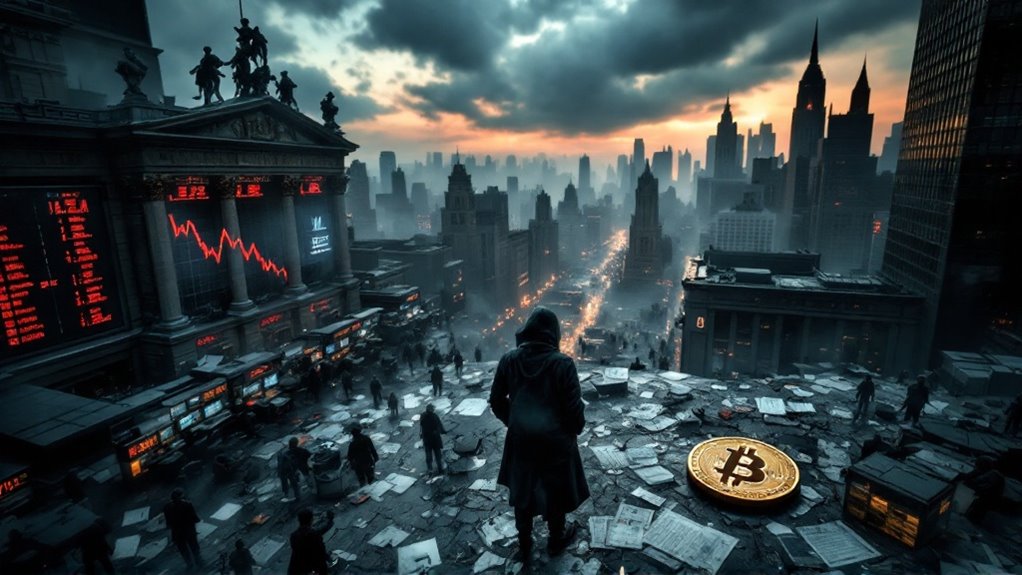
Wall Street’s Single-Day Collapse Dwarfs Entire Crypto Universe’s Value
While investors often speak of market volatility as part of the game, nothing prepares them for the gut-wrenching terror of a true market collapse. Wall Street‘s darkest days make crypto crashes look like minor hiccups. No joke.
March 16, 2020 stands as a monument to modern market panic. The Dow plunged 2,997 points—nearly 13%—while the S&P 500 nosedived almost 325 points. One day. Trillions vaporized. Faster than you could say “unprecedented times.”
March 16, 2020: Wall Street’s nightmare on steroids. Nearly 13% gone in hours—a financial massacre that redefined market terror.
But 2020 was just the latest chapter in Wall Street’s horror story collection. The granddaddy of market disasters struck in October 1929. Black Monday and Black Tuesday delivered a brutal one-two punch, wiping out 25% in just 48 hours. By 1932, the Dow had hemorrhaged 89% of its value. Ouch.
Think that’s bad? The 1987 crash holds the percentage loss record. October 19 saw the S&P crater 20.5% while the Dow collapsed 22.6%. No circuit breakers back then. Just pure, unfiltered panic.
COVID-19 deserves its own paragraph of infamy. The pandemic gifted us the six largest point declines in Dow history—all within the first half of 2020. These dramatic drops followed crowd psychology patterns where fear spread among investors like wildfire, creating devastating feedback loops of selling. Market historians will dissect that period for decades.
Technology has changed, but human nature hasn’t. In 1929, primitive systems buckled under selling pressure, accelerating the downward spiral. Today’s computerized trading can amplify panic just as effectively. Different century, same result.
Recovery? Don’t hold your breath. After 1929’s devastation, the Dow took 25 years to climb back to pre-crash levels. A quarter-century of waiting. Some investors never lived to see it.
The psychology remains fascinating. In each collapse, initial panic gives way to false hope. Temporary rallies emerge, luring optimists back before crushing them again. The market plays cruel games.
When Wall Street truly collapses, it’s not just numbers on a screen—it’s retirements delayed, dreams deferred, and entire economic systems questioned. And that dwarfs any crypto crash you’ve ever witnessed. Similar to how researchers at tatsu-lab use structured JSON data to evaluate model performance, analysts systematically document market failures to better understand systemic risks.
The magnitude of Wall Street’s losses in a single trading session puts the recent digital asset collapse into stark perspective.
The unprecedented market crash highlighted the massive scale and interconnectedness of wall street monetary systems compared to emerging digital asset markets.
The unprecedented market crash highlights how deeply interconnected wall street monetary systems have become with global financial stability and investor confidence.