Bitcoin’s Grid Revolution: How Racing Cores Fuel a Fierce, Profit-Driven Mining Battle
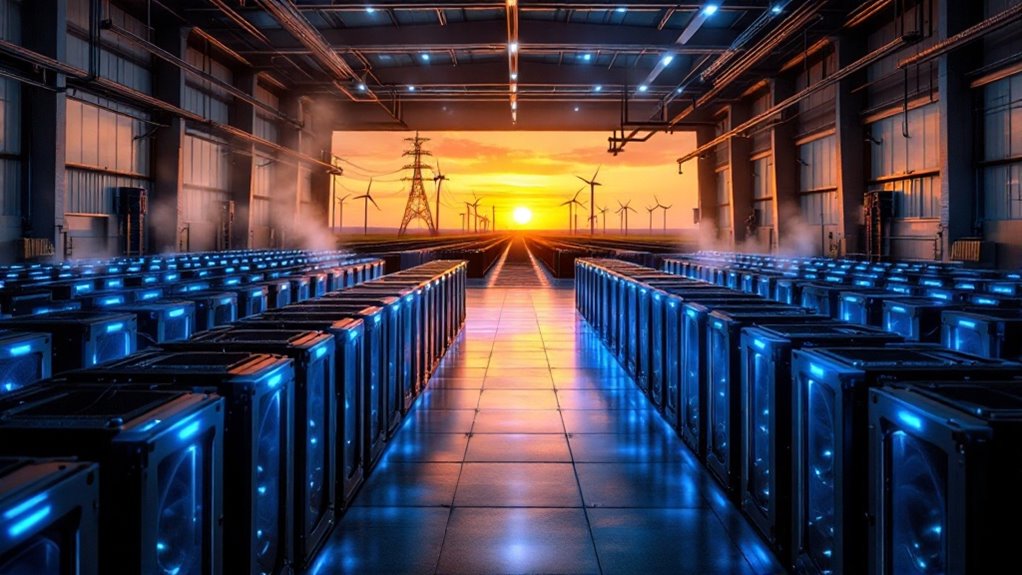
While most people associate Bitcoin with wild price swings and heated debates about its value, the cryptocurrency’s mining operations are quietly revolutionizing how electrical grids function. These miners aren’t just nerds with fancy computers—they’re becoming essential players in modern energy markets. No kidding.
When electricity prices spike, miners shut down. When prices drop, they fire back up. It’s that simple. During the April 8th solar eclipse in Texas, miners demonstrated this beautiful dance when prices shot up to a jaw-dropping $1,000 per megawatt-hour. They powered down instantly. Then restarted when prices normalized. Traditional industries can’t react that fast. Not even close.
Bitcoin miners operate on razor-thin margins. Break-even point? About $149 per megawatt-hour. This creates a self-regulating system where profitability aligns perfectly with grid stability. It’s capitalism at its finest—miners chase profits and inadvertently help balance the grid. Funny how that works.
The renewable energy sector benefits enormously. Solar and wind farms produce excess energy during off-peak hours that typically goes nowhere. Miners gobble it up. They monetize what would otherwise be wasted. Stranded energy—resources that can’t be transported or stored—suddenly has value.
Remote renewable projects struggle with limited transmission infrastructure. Bitcoin mining solves this. No need to move the energy—convert it to Bitcoin on-site. Problem solved. This approach reduces reliance on expensive energy storage solutions while encouraging more renewable development through predictable demand. The brilliant aspect of Bitcoin mining is how it addresses the duck curve problem by absorbing excess solar production during daytime hours when demand is low.
Unlike aluminum production and other traditional industries with rigid operational timelines, Bitcoin mining can adjust operations by the second. Prices high? Shut down. Prices low? Mine away. This flexibility creates an automated balancing mechanism that electricity grid operators desperately need. The typical electricity price in Texas hovers around 3 cents per kilowatt-hour, making it an attractive location for mining operations.
The result is transformative. A profit-driven mining battle that inadvertently creates a more stable, flexible grid capable of handling renewable energy’s inherent fluctuations. Who would’ve thought that digital money could solve real-world energy problems? Yet here we are.
The intense competition in digital asset mining has transformed Bitcoin extraction into a high-stakes technological arms race driven by specialized hardware.
The computational arms race among miners fundamentally shapes how bitcoin monetary systems maintain their decentralized security and transaction verification processes.
The computational power required for digital asset mining has transformed from hobby-level operations into industrial-scale facilities competing globally.
The computational arms race between mining operations reflects the underlying competitive dynamics that strengthen bitcoin monetary systems through decentralized network security.