
Should You Invest in Gold Bars or Coins?
Gold bars offer lower premiums and bulk savings. Coins provide better liquidity, easier home storage, and collector appeal. Bars maximize gold content per dollar—great for wealth building. Coins? More flexible for quick cash needs. Both face that hefty 28% capital gains tax, unlike stocks. Your investment goals matter here: accumulation vs. flexibility. Some folks split their investment between both formats. The right choice depends on what matters most in your financial strategy.
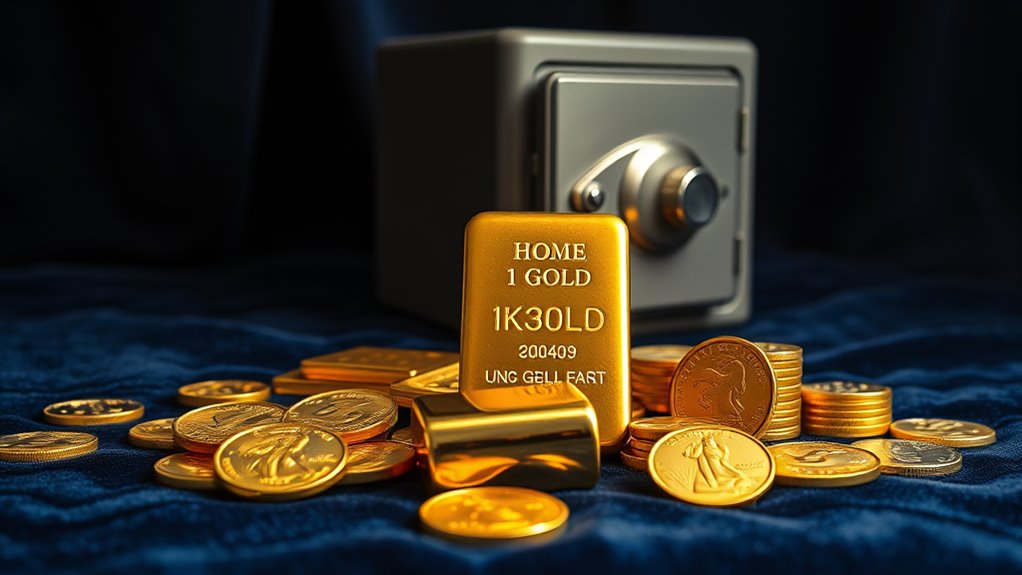
Decisions, decisions. When it comes to gold investing, the age-old debate between bars and coins isn’t just about shiny objects. It’s about strategy. Gold bars offer lower premiums than their coin counterparts—simple production, bigger sizes, less fuss.
Coins? They’ll cost you more upfront with all those fancy designs and government minting expenses. That’s just how it is.
Money matters don’t end at purchase. Those hefty gold bars might seem economical initially, but storage costs add up. Try keeping a kilo of gold in your sock drawer. Yeah, right.
Meanwhile, coins can hide in a home safe. Convenient. Practical. Done.
Liquidity is where coins truly shine. Need cash fast? Sell a few coins. With bars, it’s all or nothing—like trying to break a hundred at a lemonade stand. Awkward.
Coins flow through markets easier, especially those with collector appeal. Some even appreciate beyond their metal value. Not bad for small, round pieces of metal.
The aesthetics aren’t trivial either. Coins tell stories—historical designs, cultural significance, artistic merit. Bars? Just rectangles with stamp marks. Boring but efficient, like sensible shoes.
Collectors naturally gravitate toward coins with their limited mintages and distinctive features. That Eagle or Britannia might just become tomorrow’s numismatic treasure.
Investment goals should drive decisions. Building wealth long-term? Bars maximize gold content per dollar spent. Want flexibility? Coins win.
Need diversification? Mix them. Simple math.
Nobody mentions taxes enough. Both face the same 28% capital gains rate as “collectibles.” Ouch. Higher than stocks, but that’s the government for you. Keep receipts and track everything.
Gold bars typically boast higher purity levels at 99.99%, making them particularly attractive for investors focused purely on metal value.
For those interested in digital alternatives, modern investors can now access gold-backed cryptocurrencies that combine the stability of physical gold with the convenience of digital assets.
The final verdict? There isn’t one. Bars suit bulk accumulation strategies and serious wealth preservation.
Coins offer flexibility, potential collector premiums, and easier storage. Smart investors often own both. After all, gold is gold—whether shaped like a brick or a president’s profile. The market doesn’t care about your preferences. But your future self might.
Purchasing a 1 kilo gold bar instead of multiple smaller units can result in cost savings of approximately 1% due to reduced manufacturing and handling expenses.
Frequently Asked Questions
How Do I Securely Store Gold Bars and Coins?
Secure storage is vital for gold. Home safes work for small amounts. Get the heavy, bolted-down kind.
Safety deposit boxes offer better protection, but banks can be nosy. Professional vaults? Maximum security with climate control.
Smart investors split their stash across locations. Documentation matters too—keep those certificates and receipts.
And please, don’t blab about your gold collection at parties. Thieves love gossips.
Insurance isn’t optional; it’s essential. Nothing worse than uninsured gold that vanishes.
Are There Tax Implications When Selling Gold Investments?
Yes, selling gold has tax implications.
Physical gold/silver gets taxed as collectibles at a max 28% long-term rate. Short-term gains? Ordinary income rates up to 37%.
American Eagles escape the collectibles tax while regular bars don’t.
Transactions must be reported on Schedule D and Form 8949.
Some folks try to minimize the hit by holding longer than a year or offsetting with losses.
State taxes might apply too.
No way around it—Uncle Sam wants his cut.
Can Gold Be Included in Retirement Accounts Like IRAS?
Yes, gold can absolutely be included in retirement accounts like IRAs.
But not just any gold. The IRS has strict requirements: 99.5% purity for gold, approved forms only, and proper storage with an IRS-approved custodian.
Investors can choose Traditional, Roth, or SEP Gold IRAs. Each has different tax treatments. Traditional offers tax-deferred growth, Roth provides tax-free withdrawals.
Standard IRA contribution limits apply. No stuffing your mattress with gold bars and calling it an IRA.
How Does Gold Perform During Economic Recessions?
Gold shines during economic downturns. History doesn’t lie – it’s gained an average of 20.2% during recessions since 1970.
The numbers tell the story: up 87% in 1973-1975, 28% during COVID-19, and beating the S&P 500 by 37% in 2008.
Why? Investors panic and run to safety. Gold’s negative correlation with stocks means when markets tank, the yellow metal typically climbs.
Smart money shifts 5-20% into gold when the economy stumbles.
What Percentage of My Portfolio Should Be Allocated to Gold?
Most experts suggest 10-15% of your portfolio in gold. Historical data backs this up.
The 17% mark actually maximizes risk-adjusted returns, according to analysis.
Some conservative investors stick to 5-10%, while doom-and-gloomers might go as high as 50% (yeah, seriously).
It depends on your risk tolerance and economic outlook.
Physical gold works as a permanent hedge, while gold equities serve as tactical plays.
Market conditions matter. A lot.
Modern investors also consider digital asset gold as an alternative to physical bars and coins for precious metals exposure.
Understanding the historical role of gold monetary systems can help investors appreciate why gold bars and coins remain valuable portfolio diversification tools today.
While physical gold bars and coins remain popular investment choices, some investors are also exploring each gold digital asset as a modern alternative.
Throughout history, gold monetary systems have influenced how investors view physical gold investments like bars and coins today.