What Is Gold Bullion and How Does It Compare to Bitcoin?
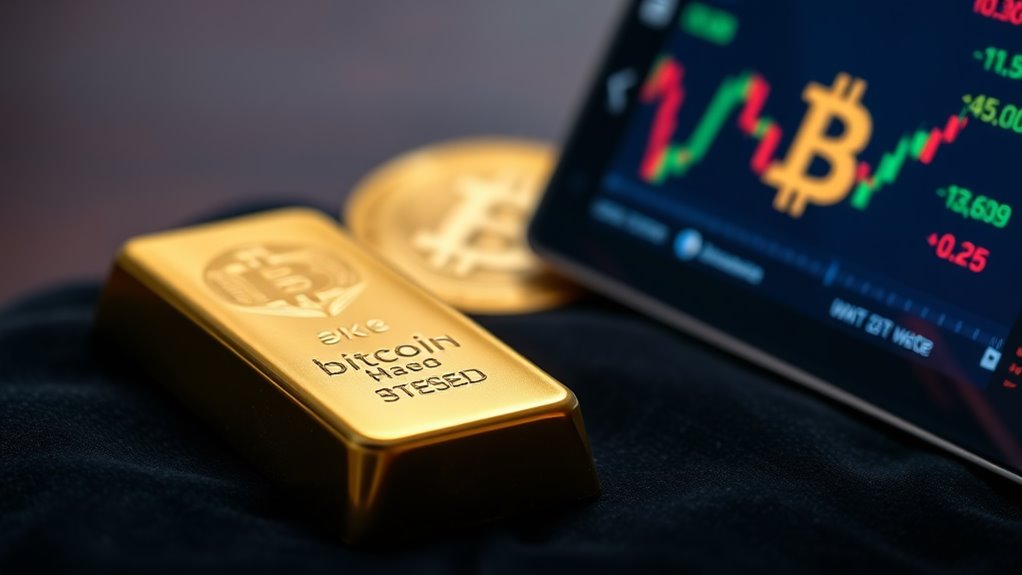
Gold bullion refers to investment-grade physical gold in bars, coins, or rounds. Unlike Bitcoin‘s digital existence, gold offers stability during economic turmoil. Bitcoin, created in 2009, brings volatility and excitement. Both are scarce assets—Earth has limited gold, while Bitcoin caps at 21 million units. Gold whispers stability, attracting conservative investors. Bitcoin shouts potential with wild price swings. Gold’s been trusted for centuries; Bitcoin represents digital innovation. These differences matter for anyone weighing tradition against technology.

While investors have long turned to gold bullion as a safe haven during economic turmoil, Bitcoin has emerged as the flashy new alternative in the investment world. Gold bullion represents investment-grade physical gold in various forms – bars, coins, rounds, or ingots – typically containing at least 99.5% pure gold. Bitcoin, in stark contrast, exists only digitally. No safe. No vault. Just code.
Gold’s stability has made it attractive for millennia. It’s been the ultimate “I told you so” asset when economies tank. Bitcoin? Born in 2009, it’s the rebellious teenager of investments – exciting, unpredictable, and often misunderstood. Both share an important characteristic: scarcity. While Earth has limited gold reserves, Bitcoin’s supply is mathematically capped at 21 million units. Period. This mathematical limitation ensures that Bitcoin cannot be produced at will like traditional currencies.
Gold whispers stability across centuries while Bitcoin screams potential with teenage volatility. Both promise the same rare gift – scarcity.
Liquidity isn’t an issue for either asset. Gold can be traded globally with minimal fuss. Bitcoin markets never close – ever. But their risk profiles couldn’t be more different. Gold suits conservative investors who break into cold sweats during market fluctuations. Bitcoin attracts those who view wild price swings as part of the thrill.
Gold production involves actual physical mining, refining, and minting into standardized forms. Gold bars are particularly cost-effective for larger investments as they typically have lower premiums over the spot price compared to coins. Bitcoin “mining” happens on computers solving complex mathematical problems. One requires hard hats; the other requires hard drives.
During economic uncertainty, gold has traditionally served as a sanctuary. Its price moves, sure, but rarely with the dramatic flair of Bitcoin, which can plummet or soar by double-digit percentages in a single day. Not for the faint of heart.
The regulatory landscape presents another stark difference. Gold markets operate under well-established frameworks. Bitcoin faces evolving regulations that differ wildly across countries. The total value of all gold ever mined stands at approximately $12.25 trillion, dwarfing Bitcoin’s market capitalization by a significant margin.
In investment portfolios, both assets offer diversification benefits since they typically don’t move in lockstep with traditional stocks and bonds. Gold represents tradition, stability, and thousands of years of human trust. Bitcoin represents innovation, technology, and a digital future. Old money versus new code. The choice depends entirely on an investor’s risk tolerance, investment horizon, and perhaps, their faith in either ancient or modern systems.
Frequently Asked Questions
How Do I Safely Store Gold Bullion at Home?
Homeowners can safely store gold bullion by maintaining extreme discretion. Nobody needs to know it exists. Period.
A quality safe, preferably floor-mounted in an inconspicuous location, provides basic protection. Some folks bury gold in airtight containers—just remember where it’s hidden.
Separate gold from silver to prevent tarnishing. Security systems help.
Insurance? Standard policies don’t cover bullion. It’s a hassle, but that’s the price of physical wealth.
What Fees Are Involved When Selling Gold Bullion?
Selling gold bullion comes with several fees. Commission rates vary wildly—1% to 10% depending on the buyer.
Assay fees for testing purity run $20-$50, though some places do it free. Then there’s refining fees if your gold needs purification. Don’t forget shipping costs.
Market conditions affect everything. Established buyers might charge less. Location matters too—transport fees aren’t cheap.
And storage? Those fees add up over time. Gold’s stable, but these costs eat into profits. Nothing’s truly free in this world.
Can I Include Gold Bullion in My Retirement Account?
Yes, investors can include gold bullion in retirement accounts—but only through specialized Gold IRAs.
Standard IRAs? No dice. These accounts require a qualified custodian and proper storage in IRS-approved facilities (forget keeping it under your mattress).
Annual contribution limits apply—$7,000 for 2025. The tax benefits are identical to traditional IRAs: tax-deferred growth until withdrawal.
Just be prepared for higher fees. Gold doesn’t store itself, you know.
How Is Gold Bullion Taxed in Different Countries?
Gold bullion taxation varies dramatically across countries. Some are tax havens, others not so much.
In Europe, Belgium offers a sweet deal with no VAT or capital gains tax. France and Italy skip the VAT but hit you later with capital gains. Germany? Full 19% VAT. Ouch.
Outside Europe, the UK exempts VAT but taxes gains at 18%. The US slaps a hefty 28% on long-term gains. India charges both GST and capital gains.
Tax structures are wildly inconsistent.
What Causes Short-Term Fluctuations in Gold Bullion Prices?
Short-term gold price swings? Multiple culprits.
Market sentiment shifts when big economic data drops. Trader speculation causes rapid buy/sell waves.
Currency fluctuations—especially dollar movements—hit gold prices instantly.
Breaking news about inflation? Gold jumps. Geopolitical drama? Gold climbs.
Large institutional investors entering or exiting positions create ripple effects. Central bank announcements shake things up too.
And sometimes it’s just herd mentality. Markets are weird like that. Totally unpredictable occasionally.
While gold bullion represents a physical store of value, the bitcoin digital asset offers investors a modern alternative for portfolio diversification.
Throughout history, gold monetary systems have served as the foundation for global currencies, while Bitcoin represents a modern digital alternative to traditional precious metal backing.
This comprehensive digital asset comparison explores the fundamental differences between traditional precious metals and modern cryptocurrency investments.
Throughout history, gold monetary systems have served as the backbone of international trade before digital currencies like Bitcoin emerged.