What Is Decentralization in Cryptocurrency?
Decentralization in cryptocurrency means no single authority controls the system. Instead, transactions get validated across multiple nodes through consensus mechanisms. No middlemen. No central banks. The network operates via distributed ledgers where users maintain direct control over their assets without asking permission. Think Bitcoin, with thousands of computers worldwide maintaining its integrity. It’s freedom from financial gatekeepers, though scalability remains an issue. The promise? Financial sovereignty for everyday people, if the tech can overcome its growing pains.
Freedom. That’s what decentralization in cryptocurrency promises. It’s about wresting control from central powers and distributing it across networks of ordinary users. No middlemen. No single authority calling all the shots. Just pure, algorithmic consensus among participants who don’t need to trust each other.
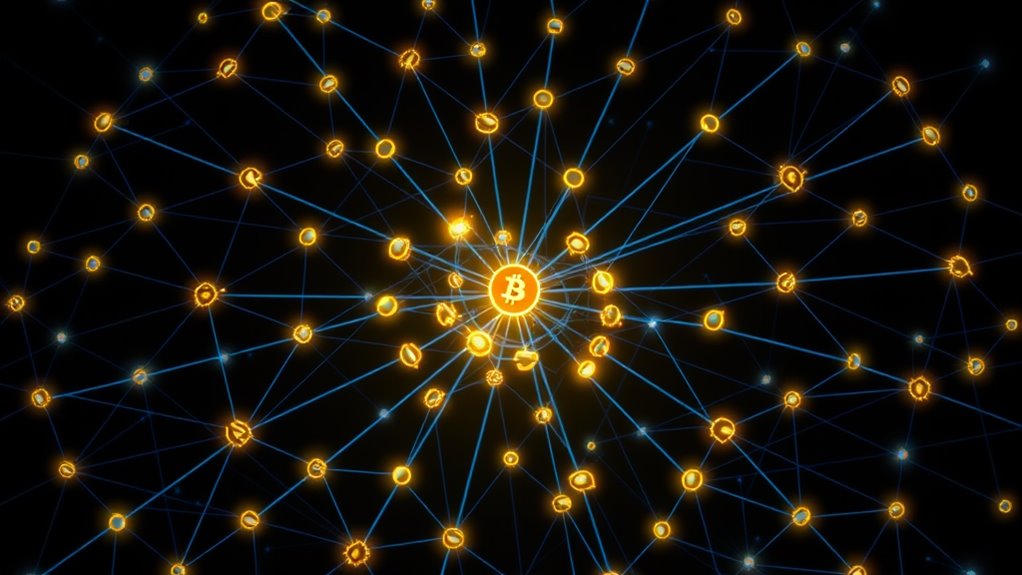
Decentralization isn’t binary—it exists on a spectrum. Some cryptocurrencies are more decentralized than others. Bitcoin, with its globally distributed nodes each holding a complete copy of the blockchain, represents architectural decentralization. These decentralized systems maintain network integrity by preventing any single entity from manipulating transactions or data.
Decentralization ranges from partial to complete, with Bitcoin’s distributed node network exemplifying the architectural ideal.
Ethereum adds political decentralization through its governance model. Ethereum 2.0 further introduces logical decentralization through its sharding solution for improved scalability. Both use consensus mechanisms to validate transactions without a central authority.
These systems have clear benefits. Security improves when validation happens across thousands of nodes instead of one central server. Transparency increases when anyone can view the public ledger. And users gain direct control of their assets. No permission needed from banks or governments. No frozen accounts. No censorship.
But it’s not all sunshine and rainbows. Decentralized networks face serious challenges. Scalability is a persistent headache—the more nodes you add, the slower things get. Energy consumption of Proof-of-Work systems is ridiculous, with Bitcoin alone using as much electricity as entire countries. Transaction processing is severely limited, with Bitcoin only capable of handling four to seven transactions per second.
Regulatory uncertainty looms large, too.
Different consensus mechanisms offer different trade-offs. Proof-of-Work (used by Bitcoin) is secure but environmentally questionable. Proof-of-Stake (Ethereum 2.0) is more energy-efficient but introduces new security considerations. Pick your poison.
Real-world applications keep expanding beyond simple transactions. DeFi platforms enable lending and trading without banks. NFT marketplaces let creators sell digital assets directly. DAOs offer organization without hierarchies. Cross-border payments happen in minutes instead of days.
The revolution isn’t perfect. Governance can be messy. Volatility scares away mainstream users. And yes, sometimes centralized solutions are actually faster. But decentralization represents a fundamental shift in how we think about trust, control, and financial infrastructure. No going back now.
Frequently Asked Questions
How Does Decentralization Impact Cryptocurrency Transaction Speed?
Decentralization slows things down. Period.
When transactions need verification from thousands of nodes instead of a few central servers, delays happen. Bitcoin’s decentralized network trades speed for security and censorship resistance.
Meanwhile, more centralized cryptocurrencies like Solana zoom ahead with faster transactions but sacrifice true decentralization. It’s a classic trade-off.
More nodes equals more security, fewer points of failure—but also means your coffee purchase might take 10 minutes to confirm. That’s crypto life.
Can a Decentralized Cryptocurrency Become Centralized Over Time?
Yes, cryptocurrencies can absolutely slide into centralization.
Hash power concentration happens – just look at Bitcoin mining pools. Economic reality kicks in: expensive hardware, high energy costs. The rich get richer.
Proof-of-stake? Same problem when whales control most tokens. Development teams become untouchable power centers.
Geographic clustering of nodes creates vulnerability. Even governance gets captured by insiders.
Decentralization isn’t permanent – it’s a constant battle against human nature and economics.
What Security Risks Are Unique to Decentralized Cryptocurrencies?
Decentralized cryptocurrencies face unique security nightmares.
51% attacks let malicious actors hijack consensus mechanisms.
No central authority? No safety net when private keys are lost or stolen—your crypto’s gone forever, buddy.
Smart contracts are sitting ducks for exploits; once hacked, you can’t exactly call customer service.
The immutable nature of blockchain? Great until something goes wrong. Then it’s just immutably broken.
Oh, and those “decentralized” networks? Often just logically centralized anyway.
Security paradox, much?
How Do Decentralized Cryptocurrencies Handle Regulatory Compliance?
Decentralized cryptocurrencies exist in a regulatory gray zone. No central authority means no single compliance point—that’s the whole idea. Regulators are scrambling to catch up.
Projects implement varying compliance measures: some build KYC into protocols, others remain defiantly anonymous. DeFi platforms often create legal entities to interface with regulators while keeping protocols decentralized.
It’s a cat-and-mouse game. Governments want control; crypto wants freedom. The tension isn’t going away anytime soon.
What Role Do Miners Play in Maintaining Cryptocurrency Decentralization?
Miners are the backbone of crypto decentralization. They validate transactions and secure the network through computational work—no central authority needed.
By competing to solve puzzles, they prevent any single entity from controlling the system. Miners distribute power globally, making 51% attacks economically stupid. Their profit incentives align with network integrity.
Even with concerns about mining concentration in places like the US (38% of hash rate), the system remains remarkably resistant to centralized control.
Digital asset decentralization represents a fundamental shift away from traditional centralized financial systems toward peer-to-peer networks controlled by distributed communities.
Decentralized monetary systems represent a fundamental shift away from traditional banking by distributing financial control across multiple network participants.
Digital asset decentralization represents a fundamental shift from traditional centralized financial systems to distributed networks controlled by participants rather than single authorities.
Decentralized monetary systems operate without central banks or government control, allowing peer-to-peer transactions through blockchain technology.