What Are Altcoins? Understanding Crypto Alternatives
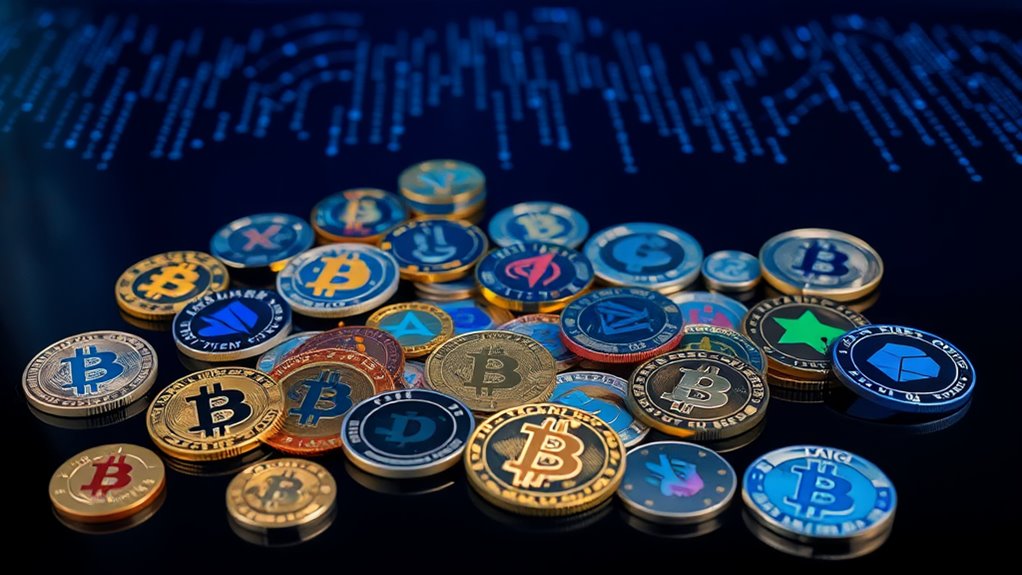
Altcoins are cryptocurrencies that aren’t Bitcoin. Period. They emerged after 2011 when developers realized Bitcoin had limitations. Now there’s over 10,000 of them, representing about 55% of crypto market cap. Some solve actual problems – Ethereum brought smart contracts, Monero offers privacy, Ripple handles cross-border payments. Others? Just tweaked copies hoping to cash in. They’re wildly volatile, easily influenced by tweets from billionaires. The crypto Wild West has more to offer than just its founding father.
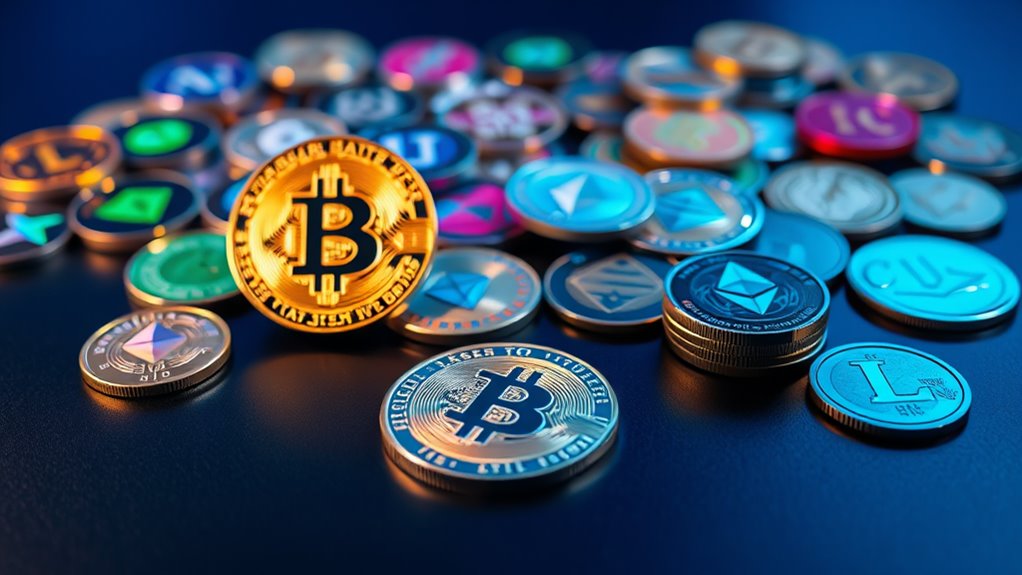
The crypto universe extends far beyond Bitcoin. While Bitcoin blazed the trail, thousands of alternatives have emerged since 2011, collectively known as “altcoins.” These digital currencies were born from Bitcoin’s limitations. Some people wanted faster transactions. Others needed different features. Developers thought, “We can do better,” and the altcoin explosion began.
Namecoin arrived first in 2011, marking the beginning. Litecoin followed that same year, introducing the Scrypt consensus mechanism instead of Bitcoin’s SHA-256. The difference? Faster blocks and lower fees. Pretty straightforward really. These early alternatives set the pattern: take what works, tweak what doesn’t, release a new coin.
Fast forward to 2023. Over 10,000 altcoins now populate the cryptosphere. Bitcoin’s market dominance plummeted from 95% in 2017 to roughly 45% today. That’s not an accident. Ethereum brought smart contracts. Monero offered privacy. Ripple focused on cross-border payments. Every problem seemingly gets its own crypto solution these days.
The technology remains fundamentally blockchain-based, but with essential modifications. Ethereum’s network, for instance, powers entire ecosystems of decentralized applications. DeFi, NFTs, governance tokens – innovations that Bitcoin simply wasn’t designed to handle. Each altcoin brings something different to the table. These alternatives can be classified as either separate coins with their own blockchain or tokens on existing platforms like Ethereum. Altcoins collectively account for over 40% of the total cryptocurrency market capitalization today.
Volatility comes standard with these smaller cryptocurrencies. Their reduced market caps mean price swings can be dramatic. One tweet from a celebrity and an altcoin might moon or crash. It’s crypto’s wild west.
The diversity is staggering. Payment tokens, utility coins, security tokens – categories keep multiplying. Many altcoins implement Proof-of-Stake (PoS) to address environmental concerns associated with Bitcoin’s energy consumption. Some survive and thrive. Others fade into obscurity. That’s just how it works. The crypto market doesn’t owe anyone success. For every Ethereum, countless failed projects litter the digital landscape.
Welcome to altcoins. They’re Bitcoin’s rebellious offspring, constantly evolving and expanding what cryptocurrency can be.
Frequently Asked Questions
How Do I Evaluate an Altcoin’s Long-Term Potential?
Evaluating an altcoin’s long-term potential requires multifaceted analysis.
Investors should scrutinize the technology’s real-world problem-solving capabilities and blockchain necessity. Tokenomics matter – examine supply distribution and governance structures.
Market liquidity and volume tell a story. The team’s credibility? Critical. Developer activity on GitHub? Even more revealing.
Partnerships and ecosystem growth signal legitimacy.
Truth is, most altcoins fail. The ones that solve actual problems tend to stick around. Not rocket science, just due diligence.
Are Altcoins More Volatile Than Bitcoin?
Yes, altcoins are typically more volatile than Bitcoin.
It’s not even close. Their smaller market caps and lower liquidity mean big trades rock the boat hard.
Price swings? Dramatic. While Bitcoin has its ups and downs, altcoins can skyrocket or crash overnight.
Regulatory news hits them harder too.
Technological experiments and updates? More frequent in altcoins, triggering price chaos.
Speculation runs wild in altcoin markets where investor sentiment—often pure emotion—drives massive volatility.
Can I Mine Altcoins on My Home Computer?
Technically yes, practically… good luck. Some altcoins still allow CPU/GPU mining, unlike Bitcoin which requires specialized hardware.
But profitability? That’s the kicker.
Home mining faces brutal challenges: electricity costs crush potential profits, hardware gets punished, and competition is fierce.
Most home setups burn more cash than they generate.
Mining pools offer slight improvement, but the days of striking it rich with a standard PC are pretty much over.
Which Exchanges Are Safest for Purchasing Lesser-Known Altcoins?
For lesser-known altcoins, Kraken stands out as extremely safe. Never been hacked since 2011. Impressive.
Binance offers massive selection (350+ coins) with decent security, though regulatory issues exist.
Coinbase? Limited altcoin selection but rock-solid security.
Gemini maintains bank-level security protocols with fewer altcoins.
KuCoin’s a dark horse—good security, tons of obscure coins.
No exchange is bulletproof though. Security and coin selection often exist in inverse relationship. That’s crypto for you.
How Are Altcoin Prices Affected by Bitcoin Market Movements?
Altcoin prices typically dance to Bitcoin’s tune. When BTC rises, altcoins often follow—sometimes with even bigger gains. During bull markets, correlation is strong (like Bitcoin-Litecoin at 0.95).
Bear markets? Different story. Altcoins usually crash harder than Bitcoin—down 90%+ versus Bitcoin’s 80% in 2018. Ouch.
Market sentiment drives this relationship. Positive Bitcoin news lifts all boats; negative news sends investors scurrying to safer options.
Occasionally, “altcoin seasons” emerge when Bitcoin stabilizes, letting alternatives shine independently.
These digital asset alternatives to Bitcoin have emerged as popular investment options, each offering unique features and blockchain technologies.
Altcoins represent innovative approaches to creating alternative monetary systems that challenge traditional banking and payment structures through decentralized blockchain technology.
Altcoins represent a diverse ecosystem of digital asset alternatives that offer unique features and use cases beyond Bitcoin’s original framework.
Altcoins represent diverse approaches to blockchain technology, each offering unique features that contribute to the evolution of crypto monetary systems.