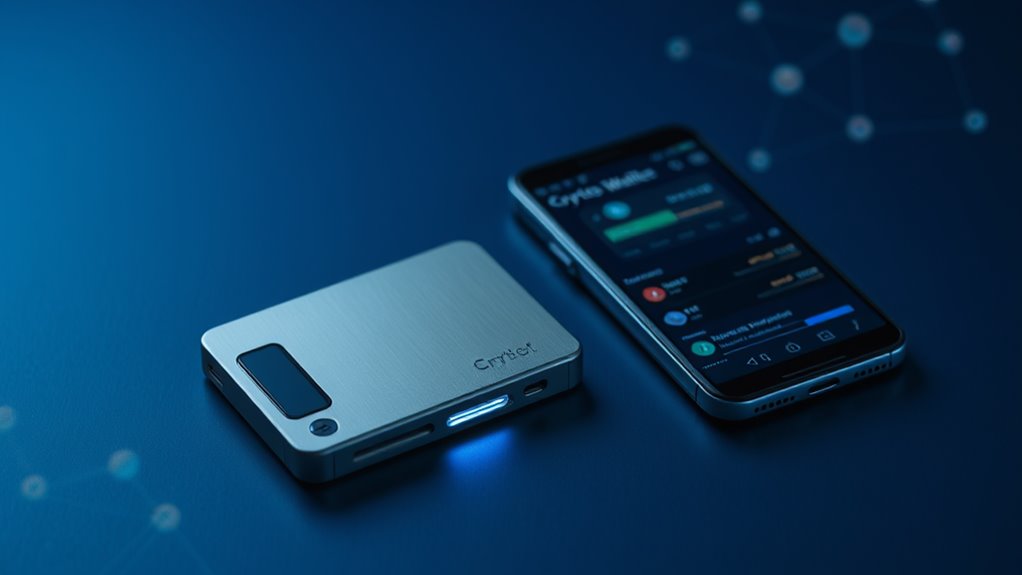
Digital Wallets: Secure Storage for Your Crypto Assets
Digital wallets serve as essential gatekeepers for cryptocurrency ownership. They store private keys—the proof of asset ownership on blockchain networks. These wallets come in different forms: hot (internet-connected), cold (offline), and mobile. Each type balances convenience with security. Without access to private keys, crypto assets become permanently inaccessible. No password resets here, folks. Users can interact with multiple cryptocurrencies and decentralized applications simultaneously. The right wallet choice depends entirely on your security needs.

As cryptocurrency continues to reshape the financial landscape, digital wallets have emerged as the essential gatekeepers to this brave new world. These digital tools aren’t just fancy apps – they’re the fundamental infrastructure that makes owning and using crypto possible for millions of people. Their primary job? Keeping those precious private keys safe and sound. Without them, your crypto might as well be floating in digital space, completely inaccessible. Not ideal.
The core functionality of crypto wallets revolves around security and access. They store private keys – those cryptographic strings that prove ownership of your assets on the blockchain. Think of them as the ultra-secure passwords to your digital fortune. Wallets let users send and receive various cryptocurrencies, often supporting multiple types simultaneously. No more single-currency limitations. Thank goodness.
These digital vaults come in different flavors. Hot wallets stay connected to the internet, making them convenient for day-to-day transactions. Quick, easy, but slightly more vulnerable. Cold wallets, meanwhile, remain completely offline. They’re the digital equivalent of stuffing cash under your mattress – except way more sophisticated and actually secure. Mobile wallets sit somewhere in between, offering convenience for on-the-go users who need crypto access from their smartphones. Modern solutions like the Arculus Cold Storage wallet provide advanced security features while maintaining user-friendly interfaces for sending and receiving crypto.
Beyond basic transactions, modern crypto wallets serve as gateways to the expanding universe of decentralized applications. Users can interact with dApps directly through their wallets. Pretty neat trick. The days of crypto being just digital money are long gone.
Perhaps most importantly, these wallets provide backup and recovery options. Lose your private keys, lose your crypto. Period. No customer service line to call, no password reset option. That’s the freedom and responsibility of truly owning your assets. It’s beautiful. It’s terrifying. The global market for cryptocurrencies has grown to a staggering over $2 trillion as of 2023, highlighting the increasing importance of secure wallet solutions. When selecting a wallet, experts recommend users carefully evaluate their security needs based on their risk tolerance and intended usage patterns.
The evolution of these digital wallets mirrors the maturation of the cryptocurrency ecosystem itself – increasingly sophisticated, more user-friendly, and gradually becoming integrated into everyday financial life. The future of money is digital, and these wallets are the new leather billfolds.
Frequently Asked Questions
Can Digital Wallets Be Hacked?
Digital wallets can absolutely be hacked. Private key theft is responsible for nearly half of crypto stolen in 2024.
Custodial wallets (held by exchanges) are particularly vulnerable. Hackers love phishing, malware, and social engineering to steal credentials. Smart contract exploits remain a problem too.
The DMM Bitcoin hack ($305M) and WazirX theft ($234.9M) prove nobody’s immune. North Korean hackers are getting bolder, targeting bigger scores.
Secure your stuff, folks.
How Much Do Hardware Wallets Typically Cost?
Hardware wallets vary widely in price.
Entry-level options like SafePal S1 ($50) and Trezor Model One ($69) won’t break the bank.
Mid-range devices include Ledger Nano X ($149) and Ellipal Titan ($169).
Premium models like Ledger Stax ($279) offer fancy screens and extra features.
For serious crypto whales, high-security options like NGRAVE ZERO hit $398.
The price jump isn’t always about security though—sometimes you’re just paying for a prettier interface.
Can I Recover My Crypto if I Lose My Wallet?
Yes, recovery is possible if a wallet is lost, but it depends on preparation.
Seed phrases are the golden ticket—12-24 words that release everything. Store them properly (not on Google Drive, obviously).
Hardware wallet users have manufacturer recovery options. Without a seed phrase? Tough luck. An estimated $140 billion in Bitcoin sits in digital limbo from lost keys.
Recovery services exist, but they’re not miracle workers. No backup, no crypto. Simple as that.
Are Mobile Wallets Safer Than Desktop Wallets?
Neither mobile nor desktop wallets are inherently safer. They just have different vulnerabilities.
Mobile wallets face malware risks through apps and physical theft concerns, but benefit from biometric authentication.
Desktop wallets can be disconnected from the internet but require manual security updates.
The real answer? It depends on your usage patterns.
Most security experts recommend a hybrid approach—mobile for daily transactions, desktop or hardware for long-term storage.
Different tools for different jobs.
Can Digital Wallets Store Multiple Types of Cryptocurrency?
Yes, digital wallets absolutely can store multiple cryptocurrencies. That’s kinda the point these days.
Called “multicurrency wallets,” these tools let users manage Bitcoin, Ethereum, Solana, and dozens of other assets in one place. Pretty convenient. Some wallets handle hundreds of different coins and tokens, while others focus on just major cryptocurrencies.
Security varies though. The all-eggs-in-one-basket approach has obvious risks. But hey, beats juggling twenty different wallets.
Modern digital asset storage solutions have revolutionized how cryptocurrency investors protect and manage their valuable holdings through advanced encryption technologies.
As digital monetary systems continue to evolve, cryptocurrency holders increasingly rely on secure digital wallets to protect their valuable assets.
Digital asset wallets have revolutionized how cryptocurrency investors store, manage, and protect their valuable holdings from potential security threats.
As digital monetary systems continue to evolve, the need for secure cryptocurrency storage solutions becomes increasingly important for investors.