Tokenomics: The Economics of Cryptocurrency Explained
Tokenomics combines “token” and “economics” to describe cryptocurrency‘s financial structure. It covers supply mechanics, distribution patterns, and token utility. Bitcoin‘s 21 million cap creates scarcity while Dogecoin remains infinitely inflationary. Red flags include developers hoarding tokens and lack of transparency. Successful projects balance token distribution, implement vesting periods, and create genuine utility. Community governance through DAOs gives token holders decision-making power. The difference between sustainable projects and flash-in-the-pan schemes? Solid tokenomics fundamentals.
Money talks. In the wild west of cryptocurrency, it practically screams. Tokenomics—a blend of “token” and “economics”—forms the backbone of every crypto project’s financial structure. It’s how developers design their digital currencies to function in the real world. No big deal, just the entire economic model that determines whether a project soars or crashes spectacularly.
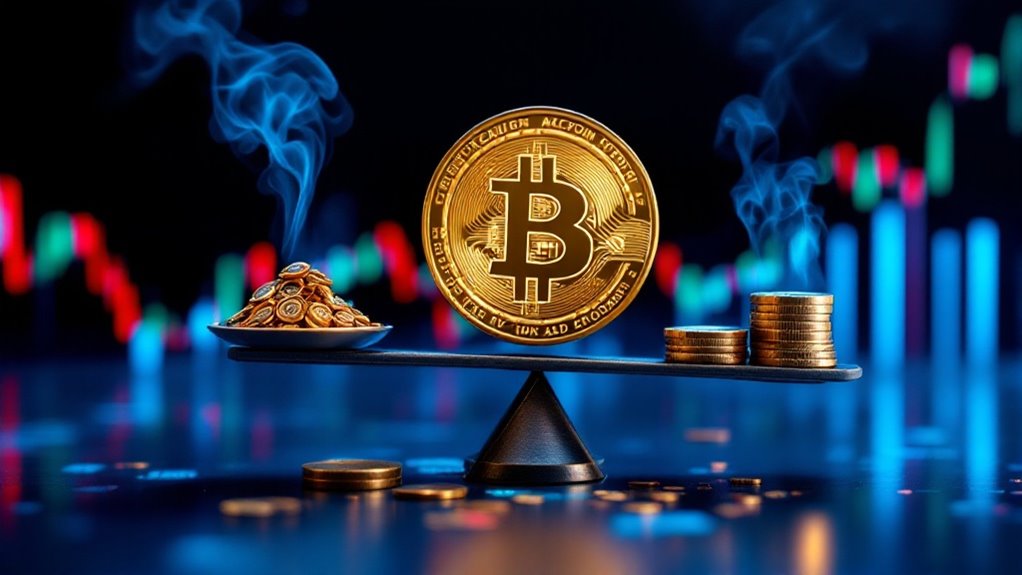
The supply of tokens matters. A lot. Bitcoin has a fixed cap of 21 million coins—scarcity by design. Dogecoin? Infinitely inflationary. Yeah, that’s a thing. Some projects even “burn” tokens, permanently removing them from circulation. Less supply, potentially more value. Basic economics, folks. These token burning mechanisms are designed to reduce overall supply and potentially increase the cryptocurrency’s value over time.
Distribution isn’t just about who gets what. It’s about power. When developers hoard 70% of tokens, that’s a red flag the size of Texas. ICOs outline these distributions, showing exactly who’s getting rich if the project succeeds. Vesting periods lock up tokens so insiders can’t dump everything on day one. Smart move.
Utility separates the contenders from the pretenders. What’s the token actually do? Some function as digital cash. Others give voting rights in governance systems. Ethereum powers smart contracts. Without utility, a token is just a digital collectible with extra steps. The whitepaper research provides essential insights into a token’s utility and its potential value within the ecosystem.
A token without genuine utility is nothing but a glorified digital baseball card wearing a financial costume.
Incentives drive behavior. Pure and simple. Staking rewards users for locking up tokens. Yield farming pays people to provide liquidity. It’s all game theory applied to digital money. People respond to incentives, and tokenomics architects know it.
Governance structures determine who calls the shots. DAOs let token holders vote on decisions. Community engagement isn’t just nice—it’s necessary. Projects without active communities die. Fast. Market performance is heavily influenced by the tokenomics model, determining both short-term volatility and long-term project sustainability.
Understanding tokenomics isn’t optional for investors. It’s the difference between backing the next revolutionary platform and throwing money at glorified digital Beanie Babies. The economics behind the token tell the real story. No sugarcoating needed.
Frequently Asked Questions
How Do Taxation Rules Apply to Crypto Token Earnings?
Crypto earnings get taxed. Period.
Mining, staking, and airdrops? That’s income tax, based on fair market value when received.
Selling or trading tokens triggers capital gains tax—rates vary depending on how long you’ve held them. Short-term gains (under a year)? Higher rates, like regular income. Long-term? Lower rates.
And yes, even using crypto for shopping creates a taxable event. The IRS isn’t playing games with this digital money stuff.
Can Tokenomics Models Predict Future Cryptocurrency Values?
Tokenomics models attempt to predict crypto values but face serious limitations.
Methods like Stock-to-Flow and NVT Ratio provide frameworks, not crystal balls. Market volatility makes things messy. Regulatory bombshells can destroy predictions overnight.
Some models show promise—Metcalfe’s Law connects user growth to value quite effectively.
But let’s be real: if anyone could perfectly predict crypto values, they’d be sipping martinis on their private island, not sharing their secrets.
What Qualifications Do You Need for Tokenomics Careers?
Tokenomics careers demand a unique skillset. Advanced degrees in economics, finance, or data science open doors.
Must-have technical skills? Programming languages like Python, statistical analysis chops, and blockchain know-how. Previous Web3 experience is gold.
The soft skills matter too. Problem-solving ability. Regulatory awareness. Understanding of market dynamics.
Not for the faint-hearted. The field evolves constantly. Continuous learning isn’t optional—it’s survival.
No token economy experts were born yesterday.
How Do Traditional Economists View Cryptocurrency Tokenomics?
Traditional economists often view cryptocurrency tokenomics with skepticism. They question the intrinsic value of digital assets and worry about market volatility. Most see tokens as speculative investments, not serious currencies.
Some economists appreciate the innovation in governance models and incentive structures. Others? They’re downright dismissive. “Ponzi schemes,” they mutter.
The debate continues to evolve though, with younger economists sometimes taking more open positions as blockchain technology matures. Academia moves slowly. Markets don’t wait.
When Should Investors Sell Tokens During Market Volatility?
Investors typically sell tokens during peak euphoria. Smart money watches sentiment indicators. When FOMO hits mainstream news? Time to evaluate exits.
Some use volatility indices, others follow contrarian strategies—buy fear, sell greed. Classic stuff.
Market-timing isn’t perfect, obviously. Portfolio rebalancing works too.
Take profits during pumps, keep some skin in the game. Breaking news can change everything in minutes.
No perfect science here, just risk management amid the crypto rollercoaster.
Understanding tokenomics is essential for anyone looking to navigate the complex world of digital asset economics and cryptocurrency investments.
Understanding tokenomics is essential for grasping how cryptocurrency monetary systems function and maintain their economic stability.
Understanding tokenomics is essential for anyone looking to grasp the fundamentals of digital asset economics in today’s cryptocurrency landscape.
Unlike traditional fiat currencies, cryptocurrency monetary systems rely on algorithmic protocols and community governance to control supply and distribution.