What Is a Seed Phrase and Why Is It Important?
A seed phrase is your crypto wallet’s master key—12-24 random words that grant access to everything. Lose it? Your money’s gone forever. No helpdesk. No password reset. Unlike banks, there’s zero safety net in crypto. Anyone who finds your phrase gets full access to your funds. It’s the ultimate “with great power comes great responsibility” situation. Metal storage beats paper, which beats digital. The rest of this crypto security story gets even more interesting.
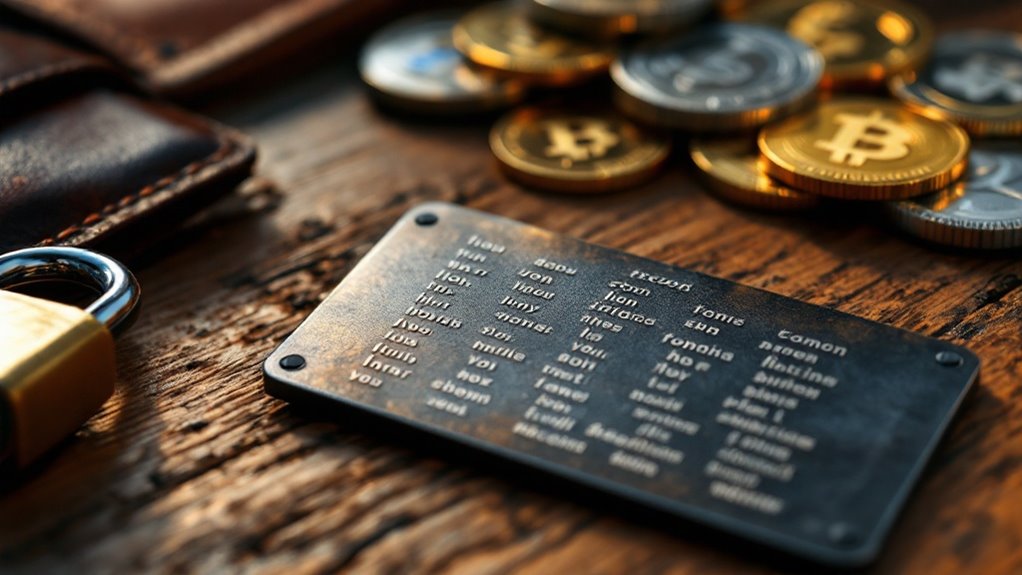
Security often hinges on the smallest details. In the crypto world, these details are 12-24 random words that might not seem important at first glance. But they are. These words form what’s called a seed phrase—essentially the master key to your digital fortune.
Your digital wealth balances on a knife edge of 12-24 random words—small details with monumental consequences.
The seed phrase serves as a backup system for cryptocurrency wallets. When you set up a wallet like MetaMask or Ledger, it generates this phrase from a standardized BIP39 list of 2,048 possible words. It’s not rocket science, just random selection. But the implications? Massive.
Think about it. Your seed phrase converts into a binary seed that creates all your private keys. Those keys sign transactions. No phrase, no keys. No keys, no access. Simple as that.
Unlike traditional banking where you can call customer service and reset your password, crypto doesn’t work that way. Forget your seed phrase? Tough luck. Your funds might as well be on Mars. There’s no 1-800 number to dial for help.
The security implications are brutal. Anyone who gets your seed phrase has everything. It’s the ultimate single point of failure. Write it down somewhere obvious? Might as well hand over your money directly. Store it digitally? Hackers are basically drooling.
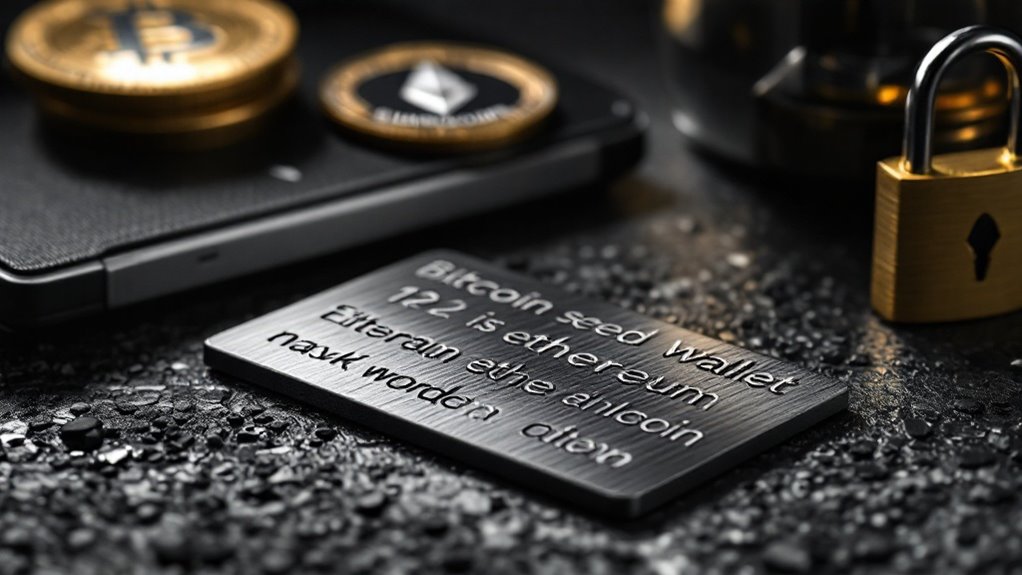
Storage options exist, of course. Paper works, but burns. Metal engravings like Cryptotag don’t burn, don’t rust. Safety deposit boxes work too. Just don’t email it to yourself. Seriously.
The difference between seed phrases and private keys matters. Private keys handle individual transactions. Seed phrases generate those keys. Lose a private key, lose some funds. Lose your seed phrase, lose everything.
Order matters too. Scramble the sequence, and you’ve created a useless jumble of words. The exact order is essential. Seed phrases are designed to be human-readable format of complex cryptographic keys that would otherwise be impossible to memorize or record accurately.
Self-custody is the point. No banks, no middlemen. Just you and your phrase. Freedom comes with responsibility, though. And in crypto, that responsibility is spelled out in exactly 12-24 words. This decentralized approach provides autonomy from centralized entities like banks while putting the full responsibility of security in your hands. Remember that your funds remain intact on the blockchain even if you lose access to your wallet, but without your seed phrase recovery, those assets become permanently inaccessible.
Frequently Asked Questions
Can Seed Phrases Be Changed or Modified After Wallet Creation?
Seed phrases cannot be changed after wallet creation. Period. They’re permanently fixed in the system.
Want a different phrase? Create a new wallet, transfer everything over. The old one’s done.
Wallet software deliberately lacks “edit seed phrase” buttons – that would defeat the whole security model.
If someone knows your phrase? They own your crypto. Simple as that.
No modifications, no do-overs. It’s a one-shot deal.
What Happens if My Seed Phrase Is Partially Damaged or Incomplete?
A damaged seed phrase is fundamentally useless.
Cold, hard truth: incomplete phrases can’t restore wallets. Period.
Missing words or incorrect order? You’re locked out for good.
The math behind crypto recovery doesn’t allow for partial solutions – it’s all or nothing.
Brute-forcing becomes theoretically possible with partial phrases, but practically impossible.
Hackers love this vulnerability.
No automated recovery tools exist for this scenario.
Crypto’s security is also its downfall.
Are All Cryptocurrency Wallets Compatible With the Same Seed Phrase Format?
No, cryptocurrency wallets aren’t universally compatible with the same seed phrase format.
Most use BIP39 standards—think MetaMask, Ledger, and Trezor. But exceptions exist.
Electrum? Uses its own proprietary format. Completely incompatible with BIP39 wallets.
Hardware wallets typically follow standards, while some custodial services like Coinbase avoid seed phrases entirely.
This fragmentation creates migration headaches.
Users switching between non-compatible wallets? They’re out of luck. No direct transfers possible.
How Often Should I Update or Rotate My Seed Phrase?
Seed phrases don’t need regular rotation. Unlike passwords, they’re meant to be permanent.
Only change it if you suspect compromise—like a sketchy website visit or potential theft. Some wallet providers might suggest updates, but it’s unnecessary risk. Moving to a new phrase means transferring all assets. Not a casual decision.
Most experts agree: set it, secure it, forget it. Physical security beats digital musical chairs any day.
Can a Seed Phrase Be Cracked Using Modern Computing Technology?
No, seed phrases can’t be cracked with modern computing technology. Period.
The math is brutal – a 24-word seed phrase has 2^256 possible combinations. That’s more than atoms in 100 billion galaxies. Even supercomputers would need billions of years.
Human error is the real vulnerability. People write phrases down, store them digitally, or fall for phishing scams.
Quantum computing? Not there yet. The phrase itself isn’t the weak link. People are.
A seed phrase serves as the foundation of digital asset security by providing the only way to recover your cryptocurrency wallet if access is lost.
Understanding seed phrase monetary systems is crucial for anyone looking to securely manage their cryptocurrency investments and digital assets.
Seed phrases play a crucial role in monetary systems security by providing the only way to recover cryptocurrency wallets if access is lost.